Understanding Metric and Normed Spaces in Daily Life

Why the General Public Should Care About Metric Spaces & Normed Spaces

Not just for mathematicians. These ideas quietly power your maps, music, medicine, finance, and AI—every single day.

TL;DR

Metric spaces tell us how close things are. Normed spaces tell us how big things are. Together, they help algorithms make good choices—like routes, recommendations, diagnoses, prices, and predictions.

On this page

Everyday Reasons to Care

🗺️ Maps

Shortest routes are calculated by measuring distances between places. That’s a metric at work.

🎵 Music & Movies

Recommendations find things “close” to your taste using a metric on features (tempo, mood, genre).

🧬 Health

Comparing DNA or medical images uses distances between sequences and scans—metrics again.

💸 Finance

Risk models measure how big your portfolio’s swings are. That’s a norm—a ruler for volatility.

🤖 AI & Search

Finding similar images, texts, or answers? Algorithms rely on distances and sizes in abstract spaces.

What’s a Metric Space? The Math of “Closeness”

A metric is a rule that tells you how far apart two things are. It could be miles on roads, differences in pixel colors, or how unlike two songs feel. Any world where you can say “this is closer than that” in a consistent way—welcome to a metric space.

Plain-language checklist for a good metric
  • Distance is never negative.
  • Only identical things have distance zero.
  • Distance from A to B equals distance from B to A.
  • Taking a detour never makes it shorter (triangle rule).

Once you can measure closeness, you can cluster, search, compress, route, and recommend—fast.

What’s a Normed Space? The Math of “Bigness” and Effort

A norm acts like a measuring tape for size, length, or effort. How big is a change? How strong is a signal? How wild is a portfolio’s swing? Norms assign a number to the magnitude of a vector (a bundle of quantities).

In everyday life

The “effort” to move furniture upstairs? Bigger object ⇒ bigger “norm.” Your body knows this math intuitively.

In data & AI

Training a model is moving through a space; the norm measures how big each step is. Too big? You overshoot.

In investing

Volatility is “size of motion.” Norms help quantify risk and keep strategies within comfort zones.

The Invisible Infrastructure of Modern Life

Behind the scenes, these abstractions run the show:

  • Navigation: Road distances, traffic-aware detours, delivery routes.
  • Recommendations: “More like this” across shops, music, and videos.
  • Healthcare: Comparing scans and genomes to spot anomalies early.
  • Cybersecurity: Flagging “not-close-enough” network behavior as suspicious.
  • Finance: Measuring shock size, clustering regimes, controlling risk.
  • Climate & weather: Distances between complex states to track shifts.

No equations on your screen. Yet the math is driving the steering wheel.

Mini “Try-It” Experiments

🎧 Playlist sanity check

Play three songs you love and one outlier you don’t. Your brain instantly “measures” distance in sound space. That’s a metric, instinctively.

🧰 Weekend project sizing

List tasks, estimate effort from 1–10. You just defined a norm on your to-do “vectors.” Bigger total? Harder weekend.

🛣️ Commute game

Compare routes by time, not miles. Different metric, different “best” path. Metrics change outcomes.

Quick FAQ

Are metric and norm the same?
No. A metric measures distance between two things. A norm measures the size of one thing. They’re related but not identical.


Do I need advanced math to benefit?
Not at all. Knowing these ideas exist helps you ask smarter questions about the tools you already use.


Why does this matter now?
Because AI, personalization, logistics, and finance all depend on “closeness” and “bigness.” Better measures ⇒ better decisions.

Bottom Line

Metric spaces help us decide what’s nearby. Normed spaces help us judge what’s big. When we quantify closeness and bigness well, technology feels smarter, services feel personal, and choices get clearer.

Micro-Glossary

  • Space: A collection of things you care about (songs, images, portfolios, locations).
  • Metric: A rule to measure distance between two things in that space.
  • Norm: A rule to measure the size or effort of a single thing in that space.

Understanding the Internet of Trust and Value

🌐 Internet of Trust vs Internet of Value: Two Pillars of the Future Web

First, we learned to send information. Then, we figured out how to send value. Now, we’re learning how to build trust. But here’s the twist—these aren’t three separate evolutions. They’re converging.

Welcome to the digital crossroads where the Internet of Trust and the Internet of Value are colliding, complementing, and rewriting what it means to interact online.

🔍 The Core Differences

Aspect Internet of Value Internet of Trust
Purpose Enables fast, borderless transfer of assets (money, tokens, rights) Ensures authenticity, identity, and consent in digital interactions
Core Technologies Cryptocurrencies, smart contracts, interoperable ledgers Decentralized identity (DID), verifiable credentials, ZK-proofs
Focus Transfer of economic value Validation of truth, identity, and source
Use Cases Cross-border payments, DeFi, NFTs, tokenization of assets Digital ID, anti-fraud systems, secure voting, AI auditability
Goal Frictionless economic exchange Trusted, human-centered interactions

🌉 Where They Overlap

These aren’t rivals—they’re dance partners. The Internet of Value needs trust to scale. The Internet of Trust needs value rails to reward integrity.

Example: A smart contract may transfer $500, but how do you trust the sender’s identity or the intent? That’s where verifiable credentials (IoT) plug into financial automation (IoV).

Together, they enable a secure and equitable economy built on programmable rules, not blind trust.

🚧 Challenges Ahead

  • Regulatory uncertainty: Crypto policies lag behind innovation. Privacy laws are fragmented.
  • Digital literacy: Most people can’t define “wallet” or “verifiable credential,” let alone use them.
  • Infrastructure gaps: Many systems still depend on legacy institutions for final trust decisions.

🌎 A Synthesis Is Inevitable

Think about it. Value without trust? That’s a scam. Trust without value? That’s idealism with no traction.

The future web will not ask you to choose between the two. It will demand that both coexist—seamlessly, invisibly, and universally.

“We’re not building apps. We’re building a civilization.” – Web3 Ethos

The Internet of Trust ensures who you are. The Internet of Value enables what you can do. Together, they unlock why we connect at all.

Investing in Web4: Future-Proof Your Portfolio

🚀 Web4: How to Invest in & Build the Internet of the Future

Web1 gave us documents. Web2 gave us social networks. Web3 gave us decentralization. Now, Web4 is emerging—context-aware, AI-native, privacy-respecting, ambient, and immersive. It’s not a buzzword. It’s the next evolution. And yes, you can invest in it—or build it.

💰 Investing in the Next Web

Comparison Table: Investment Opportunities by Sector

Opportunity Sector Risk Level Expected Time Horizon
NVIDIA (NVDA)AI HardwareLow-Med1–3 years
Palantir (PLTR)Data IntelligenceMedium2–5 years
Meta Platforms (META)Spatial ComputingMedium2–5 years
Apple (AAPL)Consumer HardwareLow1–3 years
Snowflake (SNOW)Cloud & DataMedium2–4 years
Helion EnergyFusion EnergyHigh5–10 years
Worldcoin / Tools for HumanityDigital IdentityHigh4–7 years
OpenAI / AnthropicAI SoftwareHigh3–6 years
Unstoppable Domains / ENSDecentralized WebHigh3–6 years
Arweave (AR)Decentralized StorageHigh3–6 years
OCEAN ProtocolData MarketplacesHigh4–7 years
Render (RNDR)GPU RenderingHigh3–5 years
Threshold (T)Privacy InfrastructureHigh4–7 years

🛠️ How to Build for Web4

  • AI: Learn to use LLMs like GPT-4, LLaMA3, Claude, and build autonomous agents with LangChain or AutoGen.
  • Web3: Use Solidity, Foundry, and zk-SNARK tooling to build secure, composable applications.
  • Spatial Computing: Master WebXR, Unity, and RealityKit for immersive and ambient UI design.
  • Identity & Privacy: Build with DIDs, Zero Knowledge proofs, and open wallet standards.
  • Interoperability: Focus on portable avatars, encrypted cloud, and agent-to-agent protocols.

🌍 Vision: The Web as a Cognitive Mirror

The web isn’t just a screen anymore—it’s becoming an extension of your mind. Interfaces will think with you. Tools will learn from you. And the frontier will be fluid, continuous, and co-created in real time.

📌 Final Takeaway

Whether you’re a developer, investor, or futurist—now is the time. Pick a layer. Build something. Or back someone who is. Web4 is not arriving. It’s already here—and it’s waiting for your input.

Disclaimer: This content is for informational purposes only and should not be construed as financial advice. Always conduct your own due diligence.

The Future of the Web: Exploring Web4 and Beyond

🌐 The Next Frontier for the Web: Where Are We Going?

The internet has come a long way. From static HTML pages to AI-powered assistants, from blogging platforms to decentralized protocols. But now, the web is evolving again—into something stranger, smarter, and maybe even more personal. So… what’s next?

1. 🌌 Web4 and the Ambient Web

Forget Web3 for a moment. Web4 is on the horizon—an ambient, adaptive, context-aware internet. A world where your digital environment follows you, understands you, anticipates you. You won’t just use the web—you’ll live in it. Wearables, brain-computer interfaces, neural prediction models. You’ll speak, and the web will act before you finish your sentence.

2. 🧠 AI-Native Interfaces

The next frontier isn’t just mobile or AR. It’s AI-native everything. Websites will be less about pages and more about personalized, real-time experiences. LLMs like GPT will power dynamic, ever-evolving content—tailored to your needs, behaviors, and goals. Static UI? That’s already a relic.

The web of tomorrow won’t wait for your click. It will already know where you’re going.

3. 🪙 Decentralization Reboot

Web3 promised decentralization, but scalability, user experience, and regulation held it back. The next wave will refine it—not hype-driven, but utility-focused. Think verifiable identity, privacy layers, and post-blockchain architectures like DAGs and zero-knowledge rollups. Crypto will quietly evolve into the infrastructure beneath everything.

4. 🧬 Digital Identity & Sovereign Data

Say goodbye to passwords, data leaks, and owning nothing. The web ahead will revolve around user-owned identity. Your profile, your wallet, your activity—all portable, encrypted, and under your control. Projects like Worldcoin, Lens Protocol, and decentralized social networks are already exploring this space.

5. 🕶️ Spatial Web & XR

The “flat” web is becoming 3D. The spatial web—powered by augmented reality (AR), virtual reality (VR), and mixed reality (XR)—will blur the line between real and digital. Browsing will become walking, touching, interacting. Think Apple Vision Pro, Meta’s Horizon, Niantic’s real-world layers—this is just the beginning.

6. 🐣 Autonomous Agents & Personal Internets

Every user may soon have their own digital agent—a smart assistant that learns, trades, negotiates, builds apps, and protects your data. A personalized web experience that grows with you. From Siri 3.0 to ChatGPT-like entities with long-term memory and emotional calibration. Call it your second brain.

7. 🔐 Trustless Reputation & On-Chain Credibility

Fake news. Deepfakes. Spammy influencers. The future web will demand on-chain reputation systems. Verifiable credentials and cryptographic trust scores may replace follower counts. Who you are, not just what you say, will shape how algorithms treat you—and whether you’re allowed to engage.

💡 Final Thought

The web is no longer just an information space. It’s becoming a cognitive layer of reality. It sees you, hears you, adapts to you. Whether that future empowers you or controls you—depends on the choices we make today.

Want to build the web of tomorrow? Learn AI, cryptography, spatial design, and human-centered computing. The tools are here. The frontier is open.

How Network Value Increases with Users

Metcalfe’s Law: Why Networks Become More Valuable as They Grow

Metcalfe’s Law: Why Networks Become More Valuable as They Grow

Ever wondered why platforms like Facebook, Bitcoin, and LinkedIn get more valuable as more people use them? The answer lies in Metcalfe’s Law, a powerful idea that explains how networks grow in value.

🔹 What is Metcalfe’s Law?

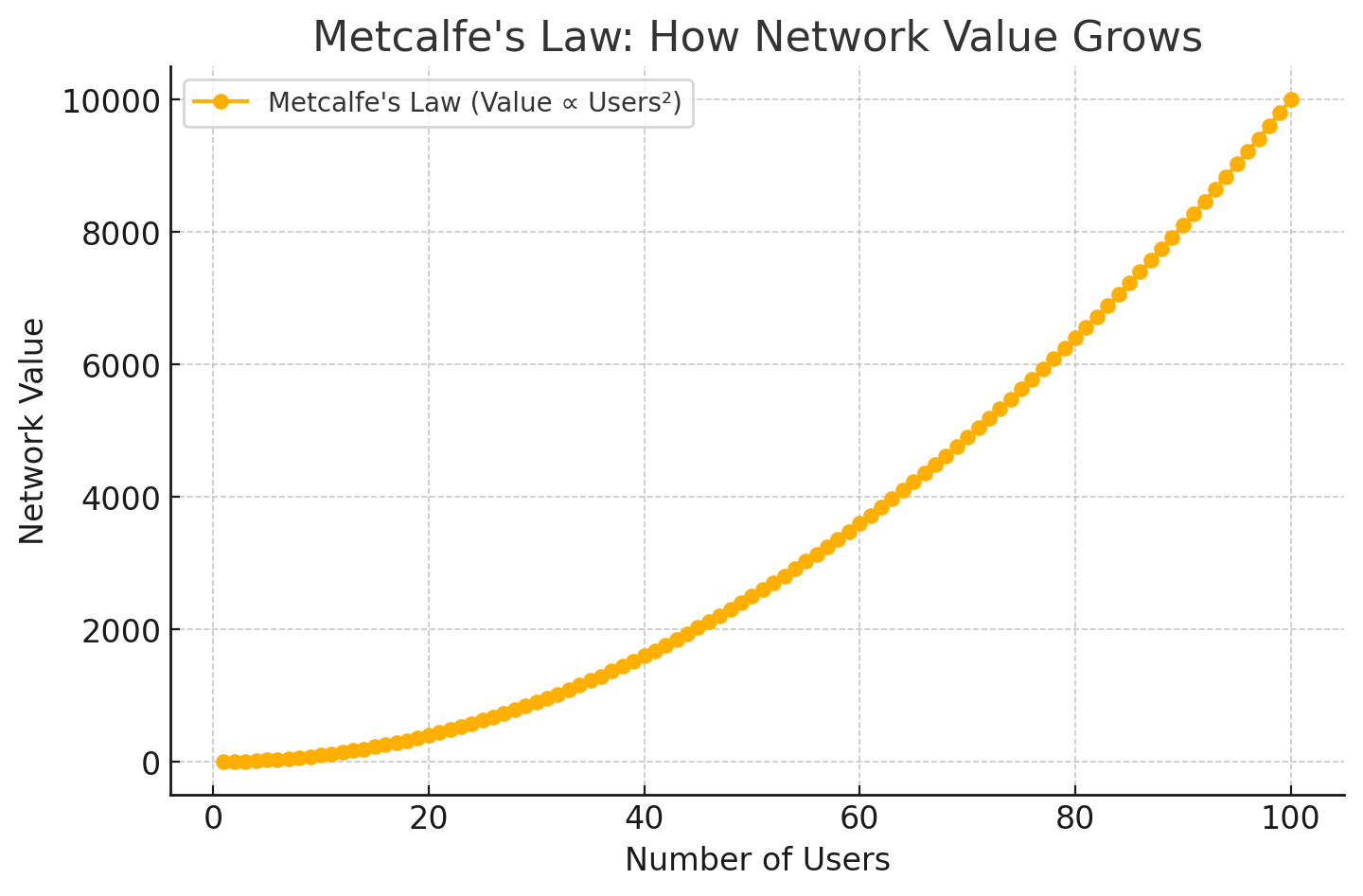
Metcalfe’s Law states that the value of a network is proportional to the square of the number of its users. In simple math terms:

Value ≈ Users²

This means that as more people join a network, its usefulness and overall value increase at a much faster rate than just the number of users.

🔹 How Does This Work?

Think about a telephone network:

  • 📞 If only one person has a phone, it’s useless.
  • 📞 If two people have phones, they can call each other—useful but limited.
  • 📞 If ten people have phones, there are 45 possible connections.
  • 📞 If 100 people have phones, there are 4,950 possible connections!

Each new user increases the number of connections exponentially, making the network far more valuable.

🔹 Real-Life Examples

1. Social Media (Facebook, Twitter, LinkedIn)

When only a few people used Facebook, it wasn’t very useful. As more people joined, it became a global platform for communication, networking, and business.

2. Cryptocurrencies (Bitcoin, Ethereum)

The more people use Bitcoin, the more valuable it becomes because it is accepted by more businesses and investors. A crypto network with just a few users has little impact, but mass adoption increases its real-world use.

3. Stock Market & Investments

Stocks of companies that benefit from network effects (like Visa, Mastercard, or Amazon) tend to grow in value as they attract more users.

🔹 How network value increase with users 📊

Below is a graph showing how network value grows exponentially with users.

Network growth

🔹 The Key Takeaway

Metcalfe’s Law shows that the true power of a network isn’t just in the number of people who join, but in how those people interact. More connections mean greater value—this is why companies like Facebook, Google, and Bitcoin become more valuable as they grow.

🚀 The bigger the network, the more valuable it becomes!

Dynamic Optimization in Finance and Beyond

Dynamic Optimization: A Simple Guide

Understanding Dynamic Optimization: A Simple Guide

Dynamic optimization is a powerful tool for making the best decisions over time in situations where things are constantly changing. It plays a crucial role in areas like investing, engineering, economics, and medicine.

🔍 What is Optimization?

Optimization simply means finding the best possible outcome under given conditions. For example, if you are saving for retirement, you want to maximize savings while minimizing risks.

⏳ What Makes It “Dynamic”?

Unlike static decisions, dynamic optimization adjusts strategies over time as new information becomes available. Imagine managing your investments: as markets shift, you tweak your plan to get better results.

📊 Examples of Dynamic Optimization in Action

  • Healthcare: Optimizing drug dosages based on patient responses.
  • Transportation: Finding the most efficient delivery routes for logistics companies.
  • Smart Cities: Managing traffic lights dynamically to reduce congestion.
  • Climate Science: Predicting and responding to changes in weather patterns.

🌍 Where is Dynamic Optimization Used?

  • Finance: Deciding the best time to buy or sell stocks.
  • Medicine: Adjusting patient treatment plans over time.
  • Robotics: Helping robots find the most efficient path.
  • Energy: Managing electricity use for cost savings.

📌 Breaking Down the Technical Terms

Bellman’s Principle of Optimality: A way of breaking down decision-making into smaller steps, commonly used in artificial intelligence.

Hamiltonian Optimization: A mathematical approach used in physics and economics to find the most efficient way to use resources.

Dynamic Programming: A method that simplifies complex problems by solving smaller, manageable parts first.

🔑 Key Takeaways

  • Dynamic optimization helps make better decisions over time.
  • It’s widely used in finance, medicine, logistics, and technology.
  • Understanding key techniques like Bellman’s Principle can improve strategic planning.

Top Google Search Tips for Long-Term Investing

Best Practices for Using Google Search for Long-Term Investing

Best Practices for Using Google Search for Long-Term Investing

Google Search is a treasure trove of information for investors. With the right techniques, you can uncover actionable insights, reliable data, and effective strategies to guide your long-term investing journey. This guide dives into best practices, shares real-world examples, answers frequently asked questions, and includes practical tips for leveraging online resources effectively.

1. Refine Your Search Queries

Specific queries yield better results. Consider these practical examples:

  • General stock searches: Instead of “good stocks”, use “top dividend-paying stocks 2025.”
  • ETF research: Try “low-cost growth ETFs 10-year performance.”
  • Sector-specific queries: Example: “best clean energy stocks 2025.”

Tip: Use Google’s autocomplete suggestions to refine your query further. Start typing your question, and Google will provide popular search ideas.

2. Use Google Search Operators

Search operators help narrow down results. Here’s how:

  • Quotes: Use quotes to search for exact phrases. Example: “best ETFs for long-term growth.”
  • Exclude terms: Add to exclude specific results. Example: “top dividend stocks -crypto.”
  • Site-specific searches: Focus on a trusted site. Example: site:morningstar.com “best performing funds.”

Tip: Combine multiple operators for precision. Example: “top dividend-paying ETFs 2025 site:investopedia.com.”

3. Utilize Trusted Resources

Knowing where to look is just as important as what to search for. Here are some key resources:

  • Financial News: Websites like Bloomberg and CNBC offer real-time updates and expert insights.
  • Research Platforms: Morningstar provides comprehensive ratings, while Yahoo Finance includes historical performance data.
  • Government Tools: The SEC Edgar database is invaluable for examining company filings and disclosures.

Example: An investor used Morningstar ratings to compare growth ETFs and identified an undervalued fund with strong long-term potential.

4. Frequently Asked Questions (FAQs)

Q: How do I know if a source is reliable?
A: Look for well-known platforms like Bloomberg, Morningstar, or government-regulated databases like SEC Edgar.

Q: What’s the best way to stay updated on market trends?
A: Use Google Alerts for terms like “best ETFs for 2025” or “latest S&P 500 news.”

Q: How can I cross-check data?
A: Compare numbers from multiple platforms and read expert analyses to ensure consistency.

5. Avoid These Common Pitfalls

  • Over-reliance on one source: No single platform has all the answers. Diversify your research.
  • Ignoring biases: Some websites may favor specific products or companies. Look for balanced perspectives.
  • Chasing trends: Avoid making impulsive decisions based on sensational headlines.

Conclusion

Google Search, when used effectively, is a powerful ally for long-term investing. By refining your queries, leveraging trusted sources, and cross-checking data, you can uncover valuable insights to guide your financial decisions. Avoid common pitfalls, stay informed, and always verify your information for the best results.

“The best investment you can make is an investment in yourself.” – Warren Buffett