Understanding the Internet of Value: Revolutionizing Transactions

šŸ’ø The Internet of Value: A New Economic Frontier

Imagine sending money as easily and instantly as sending a text message. That’s not science fiction anymore—that’s the Internet of Value. It’s about transferring assets, not just data, across the globe without friction, middlemen, or delays.

🌐 What is the Internet of Value?

The Internet of Value (IoV) refers to a digital ecosystem where value—money, stocks, identities, copyrights, deeds—can be transferred securely and instantly across the internet just like information is today.

It’s the logical evolution of the Internet of Information. We’ve moved from emailing words to streaming worlds. Now, we’re entering a realm where blockchains, cryptocurrencies, and decentralized networks enable us to move capital with the same speed and simplicity.

🧩 Key Components of the IoV

  • Blockchain Technology: Immutable, transparent ledgers that remove the need for trust in third parties.
  • Smart Contracts: Self-executing code that automates agreements and settlements.
  • Digital Tokens & Cryptocurrencies: Units of value that represent money, ownership, or utility in digital systems.
  • Interoperability Protocols: Like Ripple’s Interledger or Cosmos’ IBC, connecting different payment and asset systems.

šŸš€ Real-World Impact

The IoV disrupts entire industries—banking, real estate, art, logistics, and even governance. Micropayments become feasible. Remittances no longer lose 10% to fees. Artists sell digital originals with embedded royalties. And supply chains track goods and payments in real time.

Ethereum, XRP Ledger, Stellar, Solana, and Chainlink are at the heart of this movement—each laying bricks for a world where value flows like information.

āš–ļø Risks and Challenges

But not all is smooth sailing. Regulatory uncertainty, security vulnerabilities, and digital inequality pose barriers. While some nations embrace crypto, others outlaw it. And the risk of volatility and scams keeps many on the sidelines.

šŸ”® The Road Ahead

The Internet of Value is no longer a concept—it’s unfolding. Startups, institutions, and even governments are building on it. Whether through central bank digital currencies (CBDCs) or DeFi protocols, the infrastructure for a new global economy is rising.

The question isn’t *if* the IoV will redefine value exchange—it’s *how quickly* it will become our new normal.

“In the Internet of Value, trust becomes programmable, middlemen obsolete, and borders invisible.” – Anonymous Web3 Architect

Ready or not, the Internet of Value is rewriting the economic playbook. Will you adapt—or be left behind?

Investing in Web4: Your Guide to the Next Internet

šŸš€ Web4: How to Invest in & Build the Internet of the Future

Web1 gave us documents. Web2 gave us social networks. Web3 gave us decentralization. Now, Web4 is emerging—context-aware, AI-native, privacy-respecting, ambient, and immersive. It’s not a buzzword. It’s the next evolution. And yes, you can invest in it—or build it.

šŸ’° Investing in the Next Web

1. Public Stocks

  • NVIDIA (NVDA): The chip king powering AI, VR, and AR hardware—cornerstone of Web4 infrastructure.
  • Palantir (PLTR): Dominates data orchestration, AI pipelines, and military tech—key to real-time digital ecosystems.
  • Meta Platforms (META): Betting heavily on spatial computing and the metaverse via Horizon and Quest.
  • Apple (AAPL): Vision Pro is Web4 hardware in your hands. Their future OS might blur physical-digital boundaries.
  • Snowflake (SNOW): A cloud data powerhouse. Real-time, distributed computation matters more than ever in ambient web applications.

2. Private Startups (Venture & Pre-IPO)

  • Replika / Inflection AI: Building emotionally intelligent AI companions—agents that will anchor personal Web4.
  • Worldcoin / Tools for Humanity: Biometric-based decentralized identity systems for secure digital life.
  • OpenAI / Anthropic: The AI layer for everything. If they go public, they’ll reshape content, logic, even interfaces.
  • Unstoppable Domains / ENS: Web4 will require decentralized digital identity and wallet-first access.

3. Tokens and Protocols

  • AR (Arweave): Permanent decentralized storage for AI and immersive content.
  • OCEAN Protocol: Decentralized data marketplaces—fuel for training intelligent Web4 agents.
  • Render (RNDR): Tokenized GPU rendering infrastructure for spatial web and AI art.
  • Threshold (T): Privacy-preserving smart contract tools, a backbone for trustless Web4 ecosystems.

šŸ› ļø How to Build for Web4

1. Learn the New Stack

  • AI: Master LLMs (OpenAI, Claude, Llama3), prompt engineering, and agent frameworks (LangChain, AutoGen).
  • Web3: Build with Solidity, Zero Knowledge proofs (ZK), and smart contract orchestration using Foundry or Hardhat.
  • Spatial Computing: Unity, Unreal Engine, WebXR, and Apple’s RealityKit will be foundational for immersive UX.
  • Identity: Learn SSI (self-sovereign identity) and DIDs (Decentralized Identifiers). The wallet will replace the login.
  • Edge AI + IoT: Use tools like Edge Impulse and TensorFlow Lite to build ambient, responsive systems.

2. Focus on Interoperability

Web4 is not platform-centric. It’s user-centric. Build for protocols, not platforms. Think portable avatars, composable UIs, agent-to-agent communication, and encrypted storage.

3. Respect Privacy by Design

Surveillance capitalism is dying. The winners will be those who design AI and interfaces that respect user boundaries, consent, and digital dignity. Zero-knowledge proofs, federated learning, and on-device AI will rule.

šŸŒ Vision: The Web as a Cognitive Mirror

The next internet isn’t just about consuming information. It’s about having conversations with it. Navigating it with your eyes. Living inside it. Web4 will feel like a mirror—reflecting back your intent, in real time.

šŸ“Œ Final Takeaway

Whether you’re a developer, designer, or investor, Web4 is not some distant fantasy. It’s already under construction. The smartest move? Pick a layer—AI, identity, crypto, spatial computing—and start building. The tools are here. The market is awakening. And the future is surprisingly… writable.

Disclosure: This post is not investment advice. Always do your own research before investing in digital assets or emerging technologies.

Futures ETFs Explained: Risks and Benefits

What Are Futures ETFs? A Beginner’s Guide

šŸ“˜ What Are Futures ETFs? A Beginner’s Guide

A Futures ETF is an exchange-traded fund that uses futures contracts to gain exposure to an underlying asset like oil, Bitcoin, natural gas, or volatility — without actually holding the asset itself. These funds offer a simplified way for investors to participate in markets that might otherwise be hard to access.

šŸ“¦ How It Works

For example, if you want to invest in crude oil, you don’t need to physically own oil barrels. A crude oil futures ETF like USO buys oil futures contracts and rolls them over as they expire, keeping your exposure alive as prices change.

🧠 Key Concepts

  • Underlying Asset: The market or commodity the futures contracts are based on (e.g., Bitcoin, oil, VIX).
  • Roll Yield: The gain or loss from replacing expiring contracts with new ones.
  • Contango: When future prices are higher than current prices — can reduce returns.
  • Backwardation: When future prices are lower than spot prices — can enhance returns.

šŸ’¼ Examples of Popular Futures ETFs

ETF Underlying Type Notes
BITO Bitcoin futures Crypto First U.S. Bitcoin futures ETF
USO Crude oil Commodity Tracks WTI crude futures
UNG Natural gas Commodity Very volatile exposure
VIXY VIX futures Volatility Tracks the “fear index”

āš ļø Risks to Know

  • Tracking Error: They may not match the underlying asset’s movement 1:1 due to costs and rolling.
  • Decay: Over time, performance may erode in sideways markets due to roll costs or leverage decay.
  • Short-Term Focus: Many futures ETFs are better suited for short-term trading than long-term investing.
  • Tax Complexity: Some are taxed as futures contracts (60% long-term, 40% short-term in the U.S.).

āœ… Who Should Use Them?

Futures ETFs are useful for:

  • Getting exposure to hard-to-access markets (like commodities or volatility)
  • Hedging existing investments
  • Short-term tactical trading

šŸ“Š Bonus Example: Oil Futures ETF

If oil prices rise by 10%, an ETF like USO may only rise 7–9% due to roll costs and fees. Meanwhile, a 2x inverse ETF like SCO could fall nearly 20% if oil rises that much—because it’s betting on oil falling.


Disclaimer: This content is for informational and educational purposes only and does not constitute financial advice. Always consult with a licensed financial advisor before making investment decisions. Past performance is not indicative of future results. Futures ETFs involve risk and may not be suitable for all investors.

This One Technology Is Quietly Changing the World: Blockchain

Blockchain Explained: The Technology That’s Changing Everything

Blockchain is more than just the technology behind Bitcoin—it’s a global movement reshaping how we interact, transact, and trust in the digital world. Like the internet changed how we share information, blockchain is transforming how we share value.

šŸš€ 1. Decentralization = Power to the People

Traditional systems rely on central authorities—banks, tech giants, or governments. Blockchain flips this model, allowing peer-to-peer interactions with no middleman. That means:

  • You own your data
  • You can make transactions without a bank
  • You don’t have to rely on central institutions

šŸ” 2. Trust Without Third Parties

Blockchain uses cryptography and consensus mechanisms (like Proof of Work or Proof of Stake) to secure and validate every transaction. The result:

  • A shared, tamper-proof ledger
  • Fraud-resistant and transparent systems
  • Verifiable actions in real-time

šŸ’” 3. Smart Contracts = Automated Agreements

Smart contracts are programs that run automatically when certain conditions are met. They’re revolutionizing:

  • Business deals
  • Insurance claims
  • Real estate and supply chain payments
No middlemen, no delays—just fast, fair execution.

šŸŒ 4. Financial Access for All (DeFi)

Decentralized Finance (DeFi) opens the doors of global finance to anyone with an internet connection:

  • Digital wallets instead of bank accounts
  • Borrow, lend, and earn interest with crypto
  • Transparent, low-cost financial tools

🧩 5. Tokenization of Everything

Blockchain lets us create digital tokens representing real assets:

  • Stocks and real estate
  • Art, collectibles, even identity
  • Fractional ownership and easy trading
This gives everyone access to invest in things once reserved for the wealthy.

šŸ”— 6. Smarter Supply Chains & Records

Blockchain improves:

  • Product traceability (food, medicine)
  • Authenticity verification (anti-counterfeiting)
  • Secure, tamper-proof recordkeeping (healthcare, property)

šŸ¤– 7. The Foundation of Web3 & AI

Blockchain is powering Web3—the next era of the internet—where:

  • You own your digital identity
  • You control your data and digital assets
  • You interact with decentralized apps (dApps)
It’s trust, freedom, and innovation—built into the web.

🌟 Summary: Why Blockchain Matters

Feature Traditional Systems Blockchain
Control Centralized Decentralized
Trust Based on authority Based on code & math
Access Limited Global & open
Transparency Often hidden Fully visible
Speed & Cost Slower, expensive Faster, cheaper

If the internet was the Information Revolution, blockchain is the Trust & Ownership Revolution.

Understanding the Math Behind Meme Coins

🧮 The Surprising Math Behind Meme Coins

Meme coins like Dogecoin, Shiba Inu, PEPE, WIF, and BONK may seem like internet jokes, but there’s real math behind the madness. Whether you’re a curious investor or just meme-obsessed, let’s break down the key mathematical concepts that drive these digital coins.

1. Market Capitalization

Formula:
Market Cap = Price per Coin Ɨ Circulating Supply

This shows the total value of a meme coin. Even if a coin is priced at $0.000001, a massive supply can make its market cap billions of dollars.

2. Percentage Gain or Loss

Formula:
Percentage Change = ((New Price - Old Price) Ć· Old Price) Ɨ 100%

If PEPE goes from $0.000001 to $0.000002, that’s a 100% gain! Quick flips are common—but so are crashes.

3. Volatility (Standard Deviation)

Meme coins are wild. You can use this formula to calculate how unstable a coin is:
σ = √(Σ(x - μ)² / n)

High volatility means high risk—but also high reward.

4. Expected Return (Probabilities)

Let’s say:

  • 30% chance to double
  • 70% chance to drop 50%
Then:
Expected Return = (0.3 Ɨ 100%) + (0.7 Ɨ -50%) = -5%

Even with hype, the math might say “not worth it.”

5. Token Supply Dynamics

Many meme coins have enormous token supplies—trillions or more. If more tokens are added (minted), your share shrinks. That’s token dilution. Scarcity often makes coins more valuable.

6. Dollar Cost Averaging (DCA)

Want to reduce the risk of buying at the peak? Use DCA:
Average Price = Total Spent Ć· Total Tokens Bought

Investing consistently over time smooths out big price swings.

7. Hype-to-Value Ratio

Just for fun, try this:
Hype-to-Value Ratio = Social Media Mentions Ć· Market Cap (in millions)

A high number means there’s a lot of hype relative to its actual size—possibly a red flag… or an opportunity!

Final Thoughts

Meme coins are risky, fun, and sometimes wildly profitable. But behind the memes is math—if you understand the numbers, you’re one step ahead of the crowd. Use these formulas to sharpen your strategy, whether you’re in it for laughs, gains, or both.


🧠 Invest smart. Stay curious. Let math guide your meme coin adventures.


Disclaimer:
This article is for informational and educational purposes only. It does not constitute financial, investment, or trading advice. Meme coins are highly speculative and volatile. Always do your own research (DYOR) and consult a licensed financial advisor before making any investment decisions. The use of mathematical models does not guarantee future performance.

The Future of Financial Services: Meme Coin Innovations

šŸš€ How Meme Coin Culture Could Shape the Future of Financial Services

Meme coins like Dogecoin, Shiba Inu, PEPE, and WIF started as internet jokes — but they’re opening the doors to a new wave of financial innovation. Driven by community, culture, and hype, meme coin ecosystems could inspire a whole new set of financial services. Let’s explore what the future might look like.


šŸ”® 1. Community-Driven Investment Platforms

Think of decentralized ETFs or DAOs where the community votes on where pooled funds go. Meme coins could evolve into platforms where investors collectively decide on which tokens or startups to back — all powered by community trust and vibes.

šŸ’³ 2. Meme-Powered Microfinance & Charity

Meme coins can fuel real-world impact. Picture viral meme campaigns funding clean water projects or supporting small businesses in underbanked regions — all done via transparent blockchain donations.

šŸ’¼ 3. Gamified DeFi Products

DeFi can be fun! Inspired by meme culture, we’ll see more financial services with gamified elements — like quests to earn yields, social staking battles, or meme leaderboard competitions.

šŸ¦ 4. Meme-Based Credit & Loyalty Systems

Businesses might launch meme-style reward tokens. Instead of collecting boring points, users could earn meme coins that grant discounts, unlock special experiences, or even grow in value.

šŸŖ™ 5. Meme-Based Speculation & Derivatives

Speculators love memes. We might see meme coin indexes, options, and even futures trading platforms — so people can hedge or bet on hype in a structured way.

šŸ“Š 6. Social Sentiment Investing Tools

Meme coins rise and fall with social media trends. Future trading platforms could include AI tools that track Twitter mentions, Reddit posts, or meme virality to guide investment decisions.

🧠 7. Financial Education Through Memes

Memes make finance accessible. Meme coin communities are sparking curiosity in wallets, trading, and DeFi. They’re onboarding a new generation of investors by turning financial learning into something fun and relatable.

🌐 Bonus: Web3 Brand Tokens

Even mainstream brands could create meme-style coins to build digital communities. These tokens might offer perks like exclusive access, voting rights, or creative royalties — blending culture and value.


Meme coins aren’t just jokes — they’re seeds of a new financial future.

Meme Coins: The Future of Finance or Just a Joke?

Are Meme Coins a Joke — Or the Future of Finance?

Meme coins like Dogecoin, Shiba Inu, and Pepe may seem like internet jokes gone wild — but beneath the memes lies something much deeper. Could they be hinting at a completely new way to understand money, value, and finance?

Why Are Meme Coins So Popular?

  • Community Power: These coins thrive because of strong, passionate online communities. It’s not just about code — it’s about people.
  • Easy and Fun: They’re cheap, simple to buy, and come with meme culture built-in. Investing feels more like joining a movement than a transaction.
  • Virality: A meme coin is instantly shareable. It spreads like wildfire across Twitter, Reddit, and Telegram.
  • Speculative Thrill: The ā€œget rich quickā€ energy creates a lottery-like appeal that draws in a wide crowd.
  • A Rebellion Against Traditional Finance: These coins feel like financial punk rock — chaotic, funny, decentralized, and grassroots.

A New Paradigm of Finance?

The popularity of meme coins might be telling us something revolutionary. They are not just financial instruments — they are signals from the future of money. Here’s how:

1. Value Is Social, Not Just Economic

Traditional assets are valued based on earnings or scarcity. Meme coins are valued based on community belief and attention. If enough people care — it has value.

2. Money Itself Is a Meme

All money is a shared belief. Meme coins make this obvious. They are programmable memes with market caps.

3. Finance Becomes Fun and Cultural

Meme coins blur the line between social media and investing. They bring humor and identity into finance — not just spreadsheets and suits.

4. The Rise of the Attention Economy

In today’s world, attention is money. Meme coins live in that space — if they can capture the world’s attention, they can create real value.

So… Are They the Future?

Meme coins may not replace traditional finance, but they’re teaching us something powerful:

In a decentralized, digital world — value is culture, money is belief, and finance is becoming social.

Maybe meme coins aren’t a joke after all. Maybe they’re the beginning of a financial system built not just on logic — but on the collective imagination of the internet.

Explore more on digital assets and financial innovation.

Top Tips to Stay Safe in Crypto Investing

šŸ›”ļø Stay Safe in Crypto: A Friendly Anti-Scam Guide for Investors

The world of cryptocurrency is full of exciting opportunities—but it’s also filled with risky traps like scams and rug pulls. Before diving into any new project, it’s important to do your homework. That’s where this simple, friendly guide—based on CoinSniper’s Anti-Scam Guide—comes in. Let’s break it down so you can invest smarter and safer.

šŸ” 1. Smart Contract Safety

A smart contract is the engine that runs a crypto token. Make sure it doesn’t have any shady code that:

  • Prevents you from selling
  • Gives developers the power to change the rules
Tools to use: TokenSniffer and BSCheck

šŸ’§ 2. Check the Liquidity

Scammers may remove the token’s liquidity, leaving you with worthless coins. Always check if:

  • Liquidity is locked or burned
Example tools: DeepLock

🌐 3. Review the Website & Socials

A trustworthy project usually has a professional-looking website and active social media. Watch out for:

  • Poorly built websites
  • Telegram/Twitter with fake followers or low engagement

šŸ—ƒļø 4. Are They Listed Anywhere Reputable?

If the token is listed on trusted platforms, that’s a good sign. Look for listings on:

šŸ” 5. Security Audit Reports

Has the project been reviewed by a third-party security firm? If yes, that’s a big plus. Popular audit services include:

šŸ§‘ā€šŸ’¼ 6. Who’s Behind the Project?

If the developers are doxxed (i.e., publicly known), it increases accountability. But be sure to verify they are who they claim to be!

āš ļø 7. Use Common Sense

If something sounds too good to be true (like guaranteed 1000% returns overnight)—it probably is. Take your time and never rush into investing without doing your research.


🚨 Crypto investing can be rewarding, but also risky. Always double-check before buying any new token. Stay informed, stay alert, and don’t let the hype cloud your judgment.

Article inspired by the official guide on CoinSniper.net

How Network Value Increases with Users

Metcalfe’s Law: Why Networks Become More Valuable as They Grow

Metcalfe’s Law: Why Networks Become More Valuable as They Grow

Ever wondered why platforms like Facebook, Bitcoin, and LinkedIn get more valuable as more people use them? The answer lies in Metcalfe’s Law, a powerful idea that explains how networks grow in value.

šŸ”¹ What is Metcalfe’s Law?

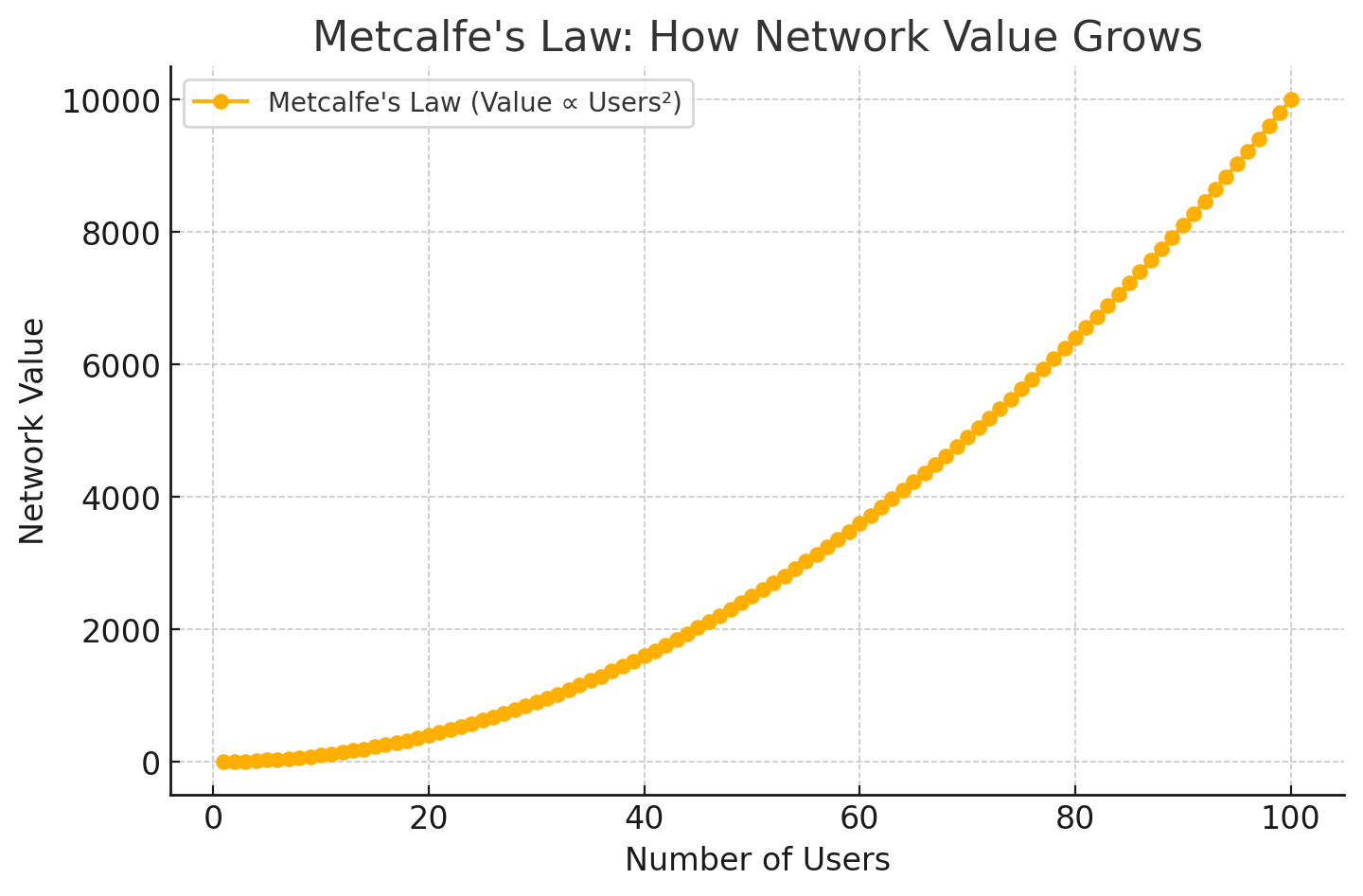
Metcalfe’s Law states that the value of a network is proportional to the square of the number of its users. In simple math terms:

Value ā‰ˆ Users²

This means that as more people join a network, its usefulness and overall value increase at a much faster rate than just the number of users.

šŸ”¹ How Does This Work?

Think about a telephone network:

  • šŸ“ž If only one person has a phone, it’s useless.
  • šŸ“ž If two people have phones, they can call each other—useful but limited.
  • šŸ“ž If ten people have phones, there are 45 possible connections.
  • šŸ“ž If 100 people have phones, there are 4,950 possible connections!

Each new user increases the number of connections exponentially, making the network far more valuable.

šŸ”¹ Real-Life Examples

1. Social Media (Facebook, Twitter, LinkedIn)

When only a few people used Facebook, it wasn’t very useful. As more people joined, it became a global platform for communication, networking, and business.

2. Cryptocurrencies (Bitcoin, Ethereum)

The more people use Bitcoin, the more valuable it becomes because it is accepted by more businesses and investors. A crypto network with just a few users has little impact, but mass adoption increases its real-world use.

3. Stock Market & Investments

Stocks of companies that benefit from network effects (like Visa, Mastercard, or Amazon) tend to grow in value as they attract more users.

šŸ”¹ How network value increase with users šŸ“Š

Below is a graph showing how network value grows exponentially with users.

Network growth

šŸ”¹ The Key Takeaway

Metcalfe’s Law shows that the true power of a network isn’t just in the number of people who join, but in how those people interact. More connections mean greater value—this is why companies like Facebook, Google, and Bitcoin become more valuable as they grow.

šŸš€ The bigger the network, the more valuable it becomes!

Cryptocurrency Investing: Long-Term vs. Short-Term Explained

Long-Term vs. Short-Term Cryptocurrency Investing Strategies

Long-Term vs. Short-Term Cryptocurrency Investing Strategies

Understanding the best investment approach for your goals

Introduction

Cryptocurrency investing involves two main approaches: short-term trading and long-term investing. Each has its own strategies, risks, and rewards. This article compares both, helping you determine the best strategy based on your financial goals.

Investment Objectives

Short-Term Investing

Short-term traders aim to make quick profits by capitalizing on price movements. This approach involves technical analysis, rapid trades, and a keen eye on market trends.

Long-Term Investing

Long-term investors believe in the fundamental value of a cryptocurrency, holding assets for years to benefit from overall market growth.

Risk Levels and Potential Returns

Short-term investing is highly volatile but offers quick potential returns. Long-term investing is steadier but requires patience through market cycles.

Market Analysis Techniques

Short-Term Traders

Use technical analysis such as chart patterns, moving averages, and trend indicators.

Long-Term Investors

Rely on fundamental analysis, evaluating a project’s technology, adoption rate, and real-world use cases.

Common Mistakes to Avoid

  • Short-term traders: Avoid overtrading and reacting emotionally to market swings.
  • Long-term investors: Avoid panic selling during downturns and failing to diversify.

Best Practices

  • Short-term traders should use stop-loss strategies and trade with a plan.
  • Long-term investors should research projects thoroughly and hold through volatility.

Examples of Cryptocurrencies for Each Strategy

Long-Term Investing

Bitcoin (BTC) and Ethereum (ETH) are ideal for long-term holding due to their strong fundamentals.

Short-Term Trading

High-volatility assets like Dogecoin (DOGE) and Pepe (PEPE) offer trading opportunities.

Conclusion

Both short-term and long-term crypto investing have advantages and risks. The best approach depends on your risk tolerance, time commitment, and market knowledge.

Disclaimer

This article is for informational purposes only and does not constitute financial advice. Cryptocurrency investments are highly volatile and risky. Always conduct your own research and consult with a professional financial advisor before making any investment decisions.