Simplifying Complex Systems with Normal Form Theory

Understanding Normal Form Theory

Understanding Normal Form Theory

Mathematics helps us make sense of complex systems, from predicting weather patterns to understanding how economies behave. But what happens when a system is too complicated to analyze directly? Normal Form Theory provides a way to simplify complex systems while keeping their essential behavior intact.

What is Normal Form Theory?

Normal Form Theory is a mathematical tool that helps us simplify equations that describe complex systems. Instead of dealing with a messy, complicated system, we transform it into a simpler version (a “normal form”) that still captures its key behavior.

Think of it like this:

  • When solving a Rubik’s Cube, it’s easier if you first simplify the colors into organized sections.
  • When cleaning a messy room, you might rearrange things so that the important stuff is easier to find.
  • In mathematics, Normal Form Theory rearranges equations to make them simpler to analyze while preserving the system’s main features.

Why Do We Need Normal Form Theory?

Many real-world systems involve nonlinear equations, meaning they don’t behave in simple, predictable ways. These systems can be:

  • A turbulent weather system with chaotic movements.
  • The stock market, where small changes can have big effects.
  • A biological system, such as population growth with predator-prey interactions.

Since these equations are often too complex to solve directly, Normal Form Theory helps by removing unnecessary complexity and making them easier to study.

How Does Normal Form Theory Work?

Normal Form Theory works by eliminating unnecessary terms in an equation to reveal the system’s true underlying behavior.

Example:

  • Imagine you’re trying to understand how a pendulum swings. Instead of considering air resistance, friction, and tiny effects that barely matter, we simplify the equation to focus on the main motion—the back-and-forth swinging.

This method helps scientists and engineers study only the most important aspects of a system without getting lost in unnecessary details.

Real-World Applications of Normal Form Theory

🔹 Physics & Engineering

Helps simplify equations for fluid dynamics, making it easier to predict turbulence. Used in mechanical systems like robotic movement.

🔹 Economics & Finance

Reduces complex market models to focus on key drivers of economic trends. Helps forecast the impact of small policy changes.

🔹 Biology & Medicine

Used in epidemiology to simplify disease-spread models. Helps in understanding heartbeat rhythms and brain activity.

Why is Normal Form Theory Important?

  • Simplifies complicated systems while preserving their essential behavior.
  • ✔ Helps scientists and engineers make accurate predictions without unnecessary complexity.
  • ✔ Provides insights into how systems evolve over time.

Final Thoughts

Even though many real-world systems are messy and unpredictable, Normal Form Theory helps us find order within the chaos.

Mathematics reveals simplicity within complexity—one transformation at a time! 🚀

Simplifying Complexity with Center Manifold Theory

Understanding Center Manifold Theory

Understanding Center Manifold Theory

Many real-world systems—like climate models, financial markets, or biological populations—are complex and often behave unpredictably. Scientists and engineers use mathematical tools to simplify these systems and understand their long-term behavior. One such tool is Center Manifold Theory, which helps reduce complexity by focusing only on the most important parts of a system.

What is a Manifold?

A manifold is a space that looks flat when viewed up close, even if it curves on a larger scale.

Examples:

  • Earth’s surface: If you stand in a field, it looks flat, but we know Earth is round.
  • Roller coaster tracks: They twist and turn, but each section appears straight when zoomed in.

Manifolds help describe how complex systems evolve over time.

Why Do We Need Center Manifold Theory?

Many systems have both fast-changing and slow-changing components. Instead of analyzing everything, Center Manifold Theory lets us focus only on the slow, important parts and ignore unnecessary details.

Examples:

  • In economics, daily stock price changes are fast, but long-term interest rates matter more.
  • In biology, predator-prey interactions fluctuate, but overall population trends are more important.

What Does Center Manifold Theory Say?

The theory states that **complex systems can be reduced to a smaller “center manifold,” which captures their essential long-term behavior**.

Instead of analyzing a huge system, we simplify it by focusing on a smaller, lower-dimensional space that still contains all the important information.

Think of it like this:

  • A car engine has thousands of parts, but to understand its movement, we mostly care about the wheels and steering.
  • A swinging pendulum can be described just by its angle and speed, without worrying about air resistance.

Real-World Applications of Center Manifold Theory

🔹 Engineering & Control Systems

Center Manifold Theory helps design **stable** aircraft, spacecraft, and robotic motion by simplifying complex control systems.

🔹 Economics & Finance

Used to model **long-term market trends** and study how economic policies affect the economy over time.

🔹 Biology & Medicine

Helps predict **disease spread** and understand how ecosystems evolve without tracking every tiny detail.

Why is Center Manifold Theory Important?

  • Simplifies complex problems without losing key insights.
  • ✔ Helps **predict system behavior** over long periods.
  • ✔ Used in **science, engineering, economics, and biology**.

Final Thoughts

Even when systems look **chaotic and unpredictable**, Center Manifold Theory helps reveal an underlying order, making sense of complexity.

Mathematics helps us find simplicity in complexity—one manifold at a time! 🚀

Exploring Nonhyperbolic Critical Points in Mathematics

Understanding Nonhyperbolic Critical Points

Understanding Nonhyperbolic Critical Points

Many systems in nature, economics, and engineering change over time. Mathematicians use critical points to understand these systems, helping predict stability and long-term behavior. While many critical points fit neatly into standard categories, nonhyperbolic critical points are trickier to analyze and require special mathematical tools.

What is a Critical Point?

A critical point (or equilibrium point) is a state where a system remains unchanged unless disturbed. Imagine a ball resting on a surface:

  • If it stays put, it’s a stable critical point.
  • If it rolls away with a small push, it’s unstable.

What Makes a Critical Point Hyperbolic?

Mathematicians classify critical points using a tool called the **Jacobian matrix**, which measures how the system reacts to small disturbances.

A critical point is **hyperbolic** if none of its special numbers (called eigenvalues) have a real part equal to zero. This means:

  • We can easily determine whether the system is stable or unstable.
  • Common hyperbolic points include saddles, nodes, foci, and centers.

What is a Nonhyperbolic Critical Point?

A **nonhyperbolic critical point** happens when at least one eigenvalue has a real part equal to zero. This means:

  • The usual methods of stability analysis **don’t work**.
  • The system’s behavior can be **complex and unpredictable**.
  • We often need **nonlinear techniques** to fully understand these points.

Real-Life Examples of Nonhyperbolic Critical Points

🔹 A Ball on a Flat Surface

If a ball is placed on a completely flat surface, it may stay still, roll slowly, or drift in an unpredictable way. This uncertainty makes it a nonhyperbolic critical point.

🔹 Traffic Flow at a Stoplight

When a traffic light turns yellow, some drivers speed up while others slow down. The decision point at yellow is unpredictable—just like a nonhyperbolic point in mathematics.

🔹 Biological Population Growth

Imagine a population that reaches a perfect balance where births equal deaths. If a disturbance (like food scarcity) occurs, the population may grow or shrink unpredictably—just like a nonhyperbolic system.

Why Are Nonhyperbolic Critical Points Important?

Since nonhyperbolic points don’t fit into standard stability categories, they are essential in studying:

  • **Complex systems** in physics and engineering.
  • **Financial models** that handle uncertainty.
  • **Chaotic behavior** in natural and artificial systems.

Final Thoughts

While hyperbolic critical points are well understood, **nonhyperbolic points reveal deeper complexity** in mathematical models. Studying them helps us better understand unpredictable systems in science, economics, and nature.

Mathematics unlocks the secrets of uncertainty—one critical point at a time! 🚀

Exploring Equilibrium: Saddles, Nodes, Foci, and Centers Explained

Understanding Saddles, Nodes, Foci, and Centers

Understanding Saddles, Nodes, Foci, and Centers

From physics to economics, understanding how systems evolve over time is crucial. One way to analyze system behavior is through **equilibrium points**, which can be categorized into **saddles, nodes, foci, and centers**. These classifications help us predict stability, oscillations, and long-term trends in real-world applications.

What is an Equilibrium Point?

An **equilibrium point** is where a system remains unchanged unless disturbed. Think of a ball on a surface—it may stay put, roll into a valley, or fall off completely, depending on the surface shape.

The Four Key Equilibrium Types

🔹 Saddle Points: Unstable Crossroads

A **saddle point** is an unstable equilibrium where movement approaches in some directions but escapes in others.

Example:

  • A ball resting on a mountain ridge—small forward/backward movements may stabilize it, but side movements will send it tumbling.
  • In economics, a saddle point can represent an unstable balance of supply and demand.

🔹 Nodes: Settling Down or Blowing Up

A **node** is an equilibrium where movement either fully **approaches** (stable) or **moves away** (unstable).

Example:

  • A **stable node** is like a marble rolling into a bowl and settling at the bottom.
  • An **unstable node** is like an ink drop in water spreading outward.

🔹 Foci: Spirals of Attraction or Repulsion

A **focus (plural: foci)** is an equilibrium where movement spirals around, either inward (stable) or outward (unstable).

Example:

  • A **stable focus** is like a spinning top that slowly comes to rest.
  • An **unstable focus** is like water spiraling outward instead of down a drain.

🔹 Centers: Perfect Orbits

A **center** is an equilibrium where movement continuously orbits around the point without ever settling or escaping.

Example:

  • A perfectly balanced **pendulum** swinging back and forth without friction.
  • Planets orbiting the sun in stable, repeating paths.

Why Does This Matter?

Understanding these equilibrium types is essential in various fields:

  • Engineering: Designing stable control systems (e.g., self-driving cars, aircraft navigation).
  • Physics: Studying forces, motion, and energy dissipation.
  • Economics: Predicting stable and unstable market conditions.
  • Biology: Modeling disease spread, predator-prey cycles, and population dynamics.

Final Thoughts

Even in complex systems, **saddles, nodes, foci, and centers** provide a structured way to analyze stability and predict long-term behavior.

Mathematics helps us find patterns in chaos—one equilibrium at a time! 🚀

The Role of Lyapunov Functions in System Stability

Understanding Stability and Lyapunov Functions

Understanding Stability and Lyapunov Functions

From airplanes to financial markets, ensuring that systems remain stable is crucial in many fields. But how do we measure stability? Enter Lyapunov functions—a powerful mathematical tool used to analyze whether a system remains steady or spirals out of control.

What is Stability?

A system is considered stable if small disturbances don’t cause it to behave unpredictably.

For example:

  • A marble in a bowl is stable—it rolls around but eventually settles at the bottom.
  • A marble on top of an upside-down bowl is unstable—even the slightest push will send it rolling away.

Mathematically, a system is stable if small changes in its starting conditions don’t cause it to drift too far from its original behavior over time.

How Do We Measure Stability?

This is where Lyapunov functions come into play. These functions help us measure whether a system will settle down or spiral out of control.

Think of a Lyapunov function as a kind of energy measure:

  • If the function always decreases over time, the system is stable—like a marble rolling to the bottom of a bowl.
  • If the function increases, the system might be unstable—like a marble perched on top of a hill, ready to roll away.

Real-Life Applications of Lyapunov Functions

Lyapunov functions are widely used in various fields to ensure stability:

  • Engineering & Robotics: Keeping airplanes stable in flight and ensuring self-driving cars maintain a safe trajectory.
  • Economics & Finance: Studying how small changes in the economy affect financial stability.
  • Biology & Medicine: Modeling disease spread to determine whether an outbreak will stabilize or grow uncontrollably.

Why is This Important?

Understanding stability and Lyapunov functions helps us:

  • Predict system behavior—will it settle or become chaotic?
  • Design stable systems—such as safe airplanes, controlled robots, and efficient economic models.
  • Control unstable systems—by making adjustments before problems arise.

Final Thoughts

Even in unpredictable environments, Lyapunov functions provide a powerful way to measure and ensure stability. Whether in engineering, economics, or biology, these functions help us keep systems under control.

Mathematics gives us the tools to bring order to chaos—one function at a time!

The Hartman-Grobman Theorem Explained

Understanding the Hartman-Grobman Theorem

Understanding the Hartman-Grobman Theorem

Mathematics helps us predict how things change over time, from the swinging of a pendulum to financial market trends. Many of these changes can be described using nonlinear differential equations, which can be difficult to solve. Fortunately, the Hartman-Grobman Theorem provides a way to simplify complex systems by approximating them with easier linear models.

Why Do We Need the Hartman-Grobman Theorem?

Imagine studying the flow of a river. In the middle, the current is wild and unpredictable, but near the shore, the movement is simpler and more predictable. Similarly, nonlinear systems can be extremely complex, but the Hartman-Grobman Theorem tells us that near an equilibrium point, we can approximate a nonlinear system with a simpler linear system.

What Does the Hartman-Grobman Theorem Say?

This theorem states that near an equilibrium point, the behavior of a nonlinear system is qualitatively the same as the behavior of its linearized version. This means:

  1. If we linearize a nonlinear system, the main features of its behavior remain unchanged.
  2. The solutions of the linearized system help us understand the original nonlinear system, at least in a small region.

Think of a curved road—when zoomed in, it looks like a straight path. The theorem allows us to “zoom in” on a nonlinear system and analyze it using a much simpler linear model.

Real-Life Applications of the Hartman-Grobman Theorem

This theorem is widely used in various scientific fields:

  • Physics – Predicting Motion: A pendulum swings nonlinearly at large angles, but for small oscillations, it behaves like a simple linear system.
  • Economics – Market Stability: Financial markets can behave unpredictably, but near stable prices, we can approximate them using linear equations.
  • Biology – Population Growth: The spread of diseases is often nonlinear, but near steady infection rates, linear models provide useful insights.

Why is the Hartman-Grobman Theorem Important?

This theorem is a crucial tool in mathematical analysis because:

  • It simplifies complex problems, making them easier to study.
  • It helps us determine stability, showing whether small changes will die out or grow over time.
  • It is used in engineering, economics, and natural sciences to develop control systems and predict behavior.

Final Thoughts

Many real-world systems are nonlinear and complex, but thanks to the Hartman-Grobman Theorem, we can study them using simpler linear models in small regions. This makes it one of the most powerful tools in understanding dynamical systems.

Mathematics helps reveal simplicity within complexity—one theorem at a time!

Exploring the Stable Manifold Theorem in Nonlinear Systems

Understanding the Stable Manifold Theorem

Understanding the Stable Manifold Theorem

Mathematics helps us understand how systems evolve over time, from predicting the weather to modeling financial markets. One powerful tool for studying long-term behavior in nonlinear systems is the Stable Manifold Theorem. Let’s explore what this means in an intuitive way.

What is a Manifold?

Before we dive into the theorem, let’s clarify what a manifold is. A manifold is a space that looks like a flat surface when viewed up close, but it can have a more complex shape on a larger scale.

Examples include:

  • A sphere (like Earth) looks flat in small regions but is curved globally.
  • A doughnut shape (torus) has curves but still has locally flat regions.

Stable and Unstable Behavior

Imagine dropping a ball into a valley. It will roll down and settle at the lowest point, returning even if disturbed. This is a stable equilibrium. On the other hand, balancing the ball on a hilltop is an unstable equilibrium—the smallest push will make it roll away.

In mathematical terms:

  • Stable manifolds: Regions where points move toward an equilibrium.
  • Unstable manifolds: Regions where points move away from an equilibrium.

What Does the Stable Manifold Theorem Say?

The theorem tells us that near an equilibrium point, the system behaves in a structured way:

  1. There exists a stable manifold—a set of points moving toward the equilibrium over time.
  2. There exists an unstable manifold—a set of points moving away from the equilibrium.
  3. The system’s behavior can be split into these two parts near the equilibrium.

This helps mathematicians predict how a system will behave when slightly disturbed.

Real-Life Applications

The Stable Manifold Theorem has many practical uses, including:

  • Weather Patterns: Stable regions lead to normal weather, while unstable regions may cause storms.
  • Stock Market Trends: Stable markets recover from shocks; unstable markets crash or boom unpredictably.
  • Spacecraft Navigation: Stable manifolds help guide objects into orbit, while unstable ones help design escape trajectories.

Final Thoughts

The Stable Manifold Theorem provides a structured way to analyze complex systems. It helps us understand stability, predict long-term behavior, and even guide engineering and scientific discoveries.

Mathematics reveals order in chaos—one theorem at a time!

The Existence-Uniqueness Theorem in Nonlinear Systems Simplified

Understanding Nonlinear Systems and the Existence-Uniqueness Theorem

Understanding Nonlinear Systems and the Existence-Uniqueness Theorem

Mathematics is full of mysteries, but some powerful theorems help us make sense of complex systems. One of the most important concepts in differential equations is the Fundamental Existence-Uniqueness Theorem, which applies to nonlinear systems. But what does this mean? Let’s break it down into simple terms.

What is a Nonlinear System?

In a nonlinear system, small changes in one variable can cause significant or unpredictable effects in another. Unlike linear systems, where everything behaves proportionally, nonlinear systems can exhibit chaos, feedback loops, or unexpected behavior.

Examples of nonlinear systems include:

  • The weather—tiny changes in temperature can lead to storms.
  • The economy—a slight increase in interest rates can cause financial shifts.
  • The human body—small changes in cells can lead to major health effects.

Local Theory of Nonlinear Systems

Instead of analyzing the entire system at once, mathematicians study how nonlinear systems behave in a small region. This is called local theory. By focusing on small sections, we can better predict and understand complex behaviors.

The Fundamental Existence-Uniqueness Theorem

This theorem helps answer two critical questions when solving differential equations:

  1. Existence: Does a solution exist?
  2. Uniqueness: Is there only one solution?

In simple terms, if certain conditions are met, a nonlinear system will have one and only one solution. Think of it like a GPS—if you follow the correct directions, you will reach your destination.

Dependence on Initial Conditions and Parameters

One crucial aspect of nonlinear systems is their dependence on initial conditions and parameters. Even small changes in these values can lead to drastically different outcomes. This is particularly important in chaotic systems, where tiny variations at the start can produce vastly different results over time.

For example:

  • In weather prediction, a slight difference in temperature readings can result in completely different forecasts.
  • In population dynamics, a small change in birth rates can affect long-term species survival.
  • In finance, adjusting interest rates by just 0.1% can influence market trends significantly.

The Existence-Uniqueness Theorem ensures that, under certain conditions, solutions depend smoothly on initial values. However, for nonlinear systems, sensitivity to initial conditions can make predictions challenging.

The Maximal Interval of Existence

The maximal interval of existence refers to the largest possible interval over which a solution to a differential equation remains valid. Even though the Existence-Uniqueness Theorem guarantees a solution, it does not necessarily mean that the solution exists for all time.

In nonlinear systems, solutions may cease to exist after a finite time due to phenomena such as:

  • Blow-up: When the solution grows indefinitely in a finite time.
  • Singularities: When a system encounters a point where it is no longer well-defined.
  • Boundary effects: When physical constraints limit the system’s evolution.

For example:

  • In physics, the motion of a pendulum may only be valid for a certain time before external forces interfere.
  • In finance, market models predicting asset prices may break down under extreme economic conditions.
  • In biology, population models may only hold until a species reaches carrying capacity.

Understanding the maximal interval of existence helps us determine whether our mathematical models remain valid over time or whether they need adjustments to accommodate real-world limitations.

Final Thoughts

Nonlinear systems might seem unpredictable, but the Fundamental Existence-Uniqueness Theorem provides a way to make sense of the chaos. By ensuring that solutions exist and are unique, mathematics gives us a reliable way to study and understand complex systems.

Mathematics brings order to chaos—one theorem at a time!

Nonlinear Systems Explained: Existence-Uniqueness Theorem

Understanding Nonlinear Systems and the Existence-Uniqueness Theorem

Understanding Nonlinear Systems and the Existence-Uniqueness Theorem

Mathematics is full of mysteries, but some powerful theorems help us make sense of complex systems. One of the most important concepts in differential equations is the Fundamental Existence-Uniqueness Theorem, which applies to nonlinear systems. But what does this mean? Let’s break it down into simple terms.

What is a Nonlinear System?

In a nonlinear system, small changes in one variable can cause significant or unpredictable effects in another. Unlike linear systems, where everything behaves proportionally, nonlinear systems can exhibit chaos, feedback loops, or unexpected behavior.

Examples of nonlinear systems include:

  • The weather—tiny changes in temperature can lead to storms.
  • The economy—a slight increase in interest rates can cause financial shifts.
  • The human body—small changes in cells can lead to major health effects.

Local Theory of Nonlinear Systems

Instead of analyzing the entire system at once, mathematicians study how nonlinear systems behave in a small region. This is called local theory. By focusing on small sections, we can better predict and understand complex behaviors.

The Fundamental Existence-Uniqueness Theorem

This theorem helps answer two critical questions when solving differential equations:

  1. Existence: Does a solution exist?
  2. Uniqueness: Is there only one solution?

In simple terms, if certain conditions are met, a nonlinear system will have one and only one solution. Think of it like a GPS—if you follow the correct directions, you will reach your destination.

Dependence on Initial Conditions and Parameters

One crucial aspect of nonlinear systems is their dependence on initial conditions and parameters. Even small changes in these values can lead to drastically different outcomes. This is particularly important in chaotic systems, where tiny variations at the start can produce vastly different results over time.

The Maximal Interval of Existence

The maximal interval of existence refers to the largest possible interval over which a solution to a differential equation remains valid. Even though the Existence-Uniqueness Theorem guarantees a solution, it does not necessarily mean that the solution exists for all time.

The Flow Defined by a Differential Equation and Linearization

When studying differential equations, we often look at the flow defined by the system. The flow describes how points in a system evolve over time according to the differential equation. Understanding the flow helps us analyze the system’s stability, long-term behavior, and sensitivity to initial conditions.

One important technique is linearization. In simple terms, this means approximating a nonlinear system by a linear one near a specific point (such as an equilibrium point). Linearization helps us determine stability and behavior by using well-understood linear methods.

For example:

  • In physics, linearizing Newton’s equations can help predict small oscillations around an equilibrium.
  • In economics, linearization can simplify models of supply and demand near equilibrium prices.
  • In biology, analyzing predator-prey interactions using linearization can help determine population stability.

By understanding the flow and using linearization, we gain deeper insights into nonlinear systems and their long-term behavior.

Final Thoughts

Nonlinear systems might seem unpredictable, but the Fundamental Existence-Uniqueness Theorem provides a way to make sense of the chaos. By ensuring that solutions exist and are unique, mathematics gives us a reliable way to study and understand complex systems.

Mathematics brings order to chaos—one theorem at a time!

How Network Value Increases with Users

Metcalfe’s Law: Why Networks Become More Valuable as They Grow

Metcalfe’s Law: Why Networks Become More Valuable as They Grow

Ever wondered why platforms like Facebook, Bitcoin, and LinkedIn get more valuable as more people use them? The answer lies in Metcalfe’s Law, a powerful idea that explains how networks grow in value.

🔹 What is Metcalfe’s Law?

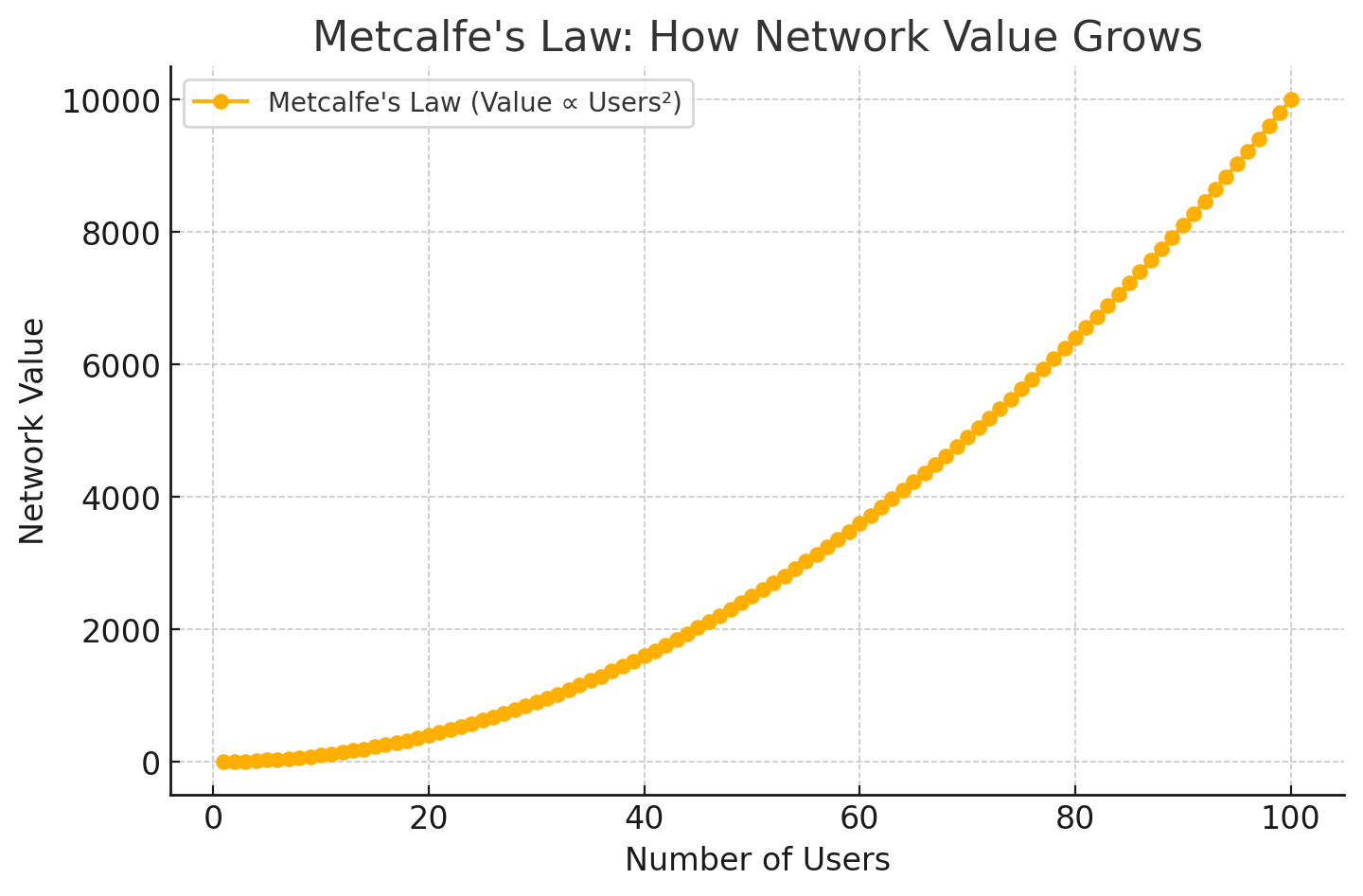
Metcalfe’s Law states that the value of a network is proportional to the square of the number of its users. In simple math terms:

Value ≈ Users²

This means that as more people join a network, its usefulness and overall value increase at a much faster rate than just the number of users.

🔹 How Does This Work?

Think about a telephone network:

  • 📞 If only one person has a phone, it’s useless.
  • 📞 If two people have phones, they can call each other—useful but limited.
  • 📞 If ten people have phones, there are 45 possible connections.
  • 📞 If 100 people have phones, there are 4,950 possible connections!

Each new user increases the number of connections exponentially, making the network far more valuable.

🔹 Real-Life Examples

1. Social Media (Facebook, Twitter, LinkedIn)

When only a few people used Facebook, it wasn’t very useful. As more people joined, it became a global platform for communication, networking, and business.

2. Cryptocurrencies (Bitcoin, Ethereum)

The more people use Bitcoin, the more valuable it becomes because it is accepted by more businesses and investors. A crypto network with just a few users has little impact, but mass adoption increases its real-world use.

3. Stock Market & Investments

Stocks of companies that benefit from network effects (like Visa, Mastercard, or Amazon) tend to grow in value as they attract more users.

🔹 How network value increase with users 📊

Below is a graph showing how network value grows exponentially with users.

Network growth

🔹 The Key Takeaway

Metcalfe’s Law shows that the true power of a network isn’t just in the number of people who join, but in how those people interact. More connections mean greater value—this is why companies like Facebook, Google, and Bitcoin become more valuable as they grow.

🚀 The bigger the network, the more valuable it becomes!